August 14, 2026
Zero trust architecture, explained without the buzzwords
"Zero trust" has been sold so hard that it stopped meaning anything. Every vendor has a zero trust product now, which is strange, because zero trust is not a product. It is one simple idea, and once you see it, the whole thing stops being a buzzword and starts being an architecture you can actually reason about.
This is the calm version. No attack demo, no scary terminal. Just the model, in plain English, and where to start if you want to move toward it.
The old model, and why it stopped working
For a long time security worked like a castle. You built a strong wall, the network perimeter, and you decided that anything inside the wall was trusted. A firewall at the edge, a VPN to let the right people in, and once you were inside, you could talk to almost anything.
That model has one fatal assumption: that being on the network means you belong there. It does not. An attacker who phishes one laptop, a contractor with a compromised password, a forgotten server with a known bug, any of them puts a hostile foot inside the wall. And inside the wall, the old model trusts them. This is why breaches spread. The break-in is one machine; the damage is everything that one machine was allowed to reach without being asked to prove anything.
The one idea
Zero trust throws out the wall. It says: no request is trusted because of where it came from. Not the office network, not the VPN, not the machine sitting in your own data center. Every single request to reach something has to prove it should be allowed, every time.
That is the whole idea. "Never trust, always verify." Everything else is just the machinery that makes it real.
The architecture, box by box
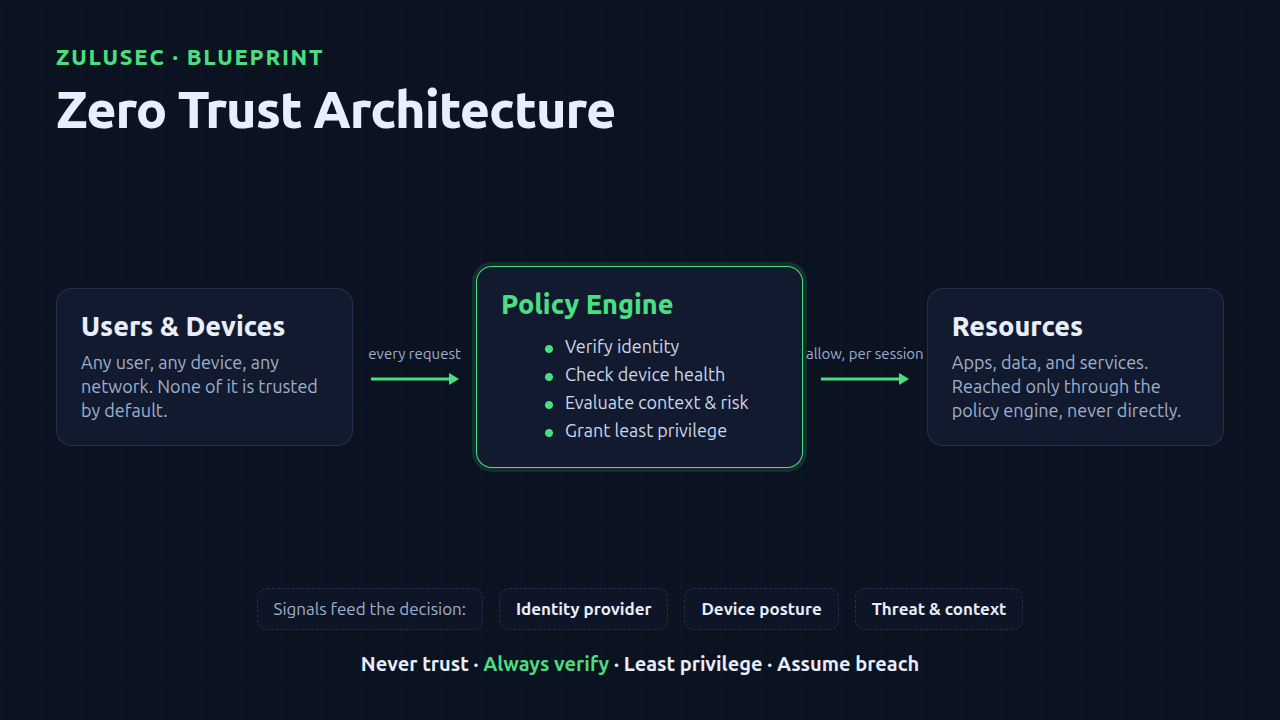
Look at the diagram at the top. There are only three parts, and the middle one is doing two jobs.
Users and devices, on the left. Any person, on any device, on any network. None of them is trusted by default. The person working from the office gets checked exactly like the person working from a coffee shop.
The policy engine, in the middle. This is the checkpoint, and it is the heart of zero trust. It is worth splitting in two, because the two halves live in different places.
One half is a gate that sits in the traffic, right in front of the resource. Every request passes through it. It does not decide anything; it enforces what it is told, and it holds the connection open or shuts it.
The other half is off the traffic path entirely. The gate asks it about a request, and it answers yes or no. NIST's model calls the gate the policy enforcement point and the decider the policy decision point, and the reason to keep them straight is practical: policy lives in one place, gates go in front of many applications, and every gate asks the same place. You change a rule once and every gate changes with it. Collapse the two and you are back to configuring each application by hand.
The decider makes a fresh decision on every request, by asking a few questions:
- Who is this? Verified identity, backed by strong authentication. A password alone is not enough; this is where multi-factor authentication and a real identity provider do their work.
- What are they on? The device itself is checked. Is it known, is it patched, is it healthy, or is it some random machine no one has ever seen?
- Does the context make sense? Where is the request coming from, at what time, does the behavior look normal or does it look like an account that was just taken over.
- How much should they get? If the answer is yes, the engine grants the least it can. Access to the one thing needed, for this session, not a skeleton key to everything.
Resources, on the right. Your apps, your data, your services. The important part: every path to them runs through a gate, never around one. There is no "inside the wall" where you can skip the checkpoint, because there is no wall. This is also where zero trust projects quietly fail. One route to a resource that no gate sits in front of, a legacy admin port, a replication link, a jump box, and the policy behind the gate stops describing what is actually reachable.
Feeding the checkpoint are the signals that make its decision smart: your identity provider, information about device health, and threat or context data. The better those signals, the better the decision.
The four principles underneath it
Everything in that diagram comes back to four rules:
- Never trust, always verify. Location proves nothing. Check every request.
- Least privilege. Grant the minimum access needed, and no more.
- Assume breach. Build as though an attacker is already inside, because one day they will be. That is what stops a single compromised laptop from becoming a company-wide incident.
- Verify continuously. Access is not a door you open once. It is checked again and again, per request, per session.
Where to actually start
You do not buy zero trust, and you do not flip a switch and have it on Monday. It is a direction you move in, and the early steps give you most of the value:
- Get identity right first. A single strong identity provider with multi-factor authentication everywhere is the foundation. Nothing else works well without it.
- Kill the flat network. Segment it so that one compromised machine cannot see and touch everything. Even coarse segmentation removes most of the blast radius.
- Put real access policies in front of your important applications instead of relying on "they are on the VPN, so they are fine."
- Cut standing privilege. Find the accounts and roles that can reach far more than they need, and tighten them. This is quiet, unglamorous, and one of the highest-value things you can do.
None of that requires ripping everything out. It is a sequence, and each step lowers your risk on its own.
Where this fits
Most teams are somewhere on this path already, usually further than they think in some areas and further behind than they hope in others. The useful work is figuring out exactly where you stand and what the highest-value next move is, rather than buying a product with "zero trust" on the box.
That is the work: mapping your current architecture, finding where implicit trust is still hiding, and laying out a phased plan to close it, across cloud, on-prem, or hybrid. If you want a target architecture and a realistic path to it, that is the zero-trust architecture engagement, and if you would rather start by finding where you are exposed today, a security audit is the place to begin.
Want a target architecture and a path to it?
A zero-trust engagement maps where your architecture still trusts the network, then lays out a phased plan to close it, across cloud, on-prem, or hybrid.
Plan your architecture